Have you followed the World Endurance Championships 2024? If you didn't, have a look at the different media available. A start in the dark in a huge thunderstorm and then 160 km of tough muddy conditions, really testing all combinations at this top level of our sport. Being a Dutchie in the UK, I supported 2 countries, cheering on both the Dut...
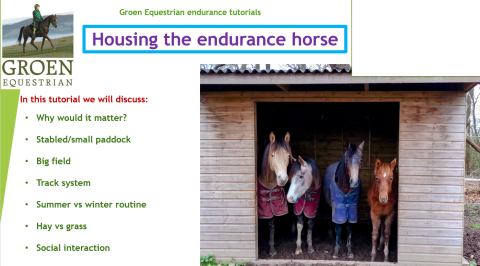
How we keep our horse will affect your endurance training and the health of your horse. Housing will affect how it can recover, how it will keep fitness but also how much nutrients and sugar the system gets. Friends or foes can also make a huge difference to your horse's well being. The housing and all these different factors influencing fitness an...
We have been working on this project for a while, and on Saturday 30th March, we began the first session of the Groen Equestrian 2024 Comparative Heart Rate Study in Banbury, Oxfordshire. As many of you have noticed, I am very interested in heart rates, particularly how various breeds of horses respond to the same workload and how we can provide be...
Another recorded webinar for you, all about the different types of horses doing endurance and how you can adapt your training and goals accordinglyAll horses can do endurance! But we just have to understand the differenced in their athletic ability and train accordingly.
This is a recorded webinar from the "Train smarter" trilogy of webinars, and it focusses on how every horse is different.You already know a lot of this because of the first series of tutorials, but it is always good to have it all in one talk.Enjoy
I have done 2 webinars about heartrate monitors (I had to: too much to tell you and both are still long ;) ) Both are fine as stand alone, but are very much part of each other if you really want to know about how to really make the best of riding with a heartrate monitor. This is the first, about different ways to measure heartrate, which systems are available (at the moment of recording, end of 2022), combining systems if you want more.
I also discuss individual range of heartrate, maximum heartrate, VO2max and the training zones often given by apps. To really understand how a heartrate monitor can be useful in training for endurance it is good to know what the aerobic threshold is (and the anaerobic threshold) and what happens within the horse when these are reached. The last thing i discuss is monitoring your horse's fitness levels by using (standardised) fitness tests.
Have a look (and remember, you can watch as many times you like within your subscription period)
Tracking and logging! But that's not all, we need to interpret what we have done as well. We have to prepare our horse correctly for what is coming. Logging is the way to see what we are doing, if we are staying near our schedule and whether we are progressing or lacking behind. You can use a diary, or a spreadsheet to log, or use the Groen Eq...
Perhaps a slightly trickier tutorial as it is a bit more abstract compared to other tutorials. But it is very good to have an idea of what the aerobic and anaerobic thresholds are and what they can mean for your training. What we want to do in endurance is to create an equine athlete that can do a (very) long distance without getting fatigued....
Let's get to the heart of the matter! The heart really is the driving force for the type of equine athlete you have. A big heart can pump more blood around the body, and that will provide more oxygen to the muscles and help move cooler blood back from the skin. Usually you can say a bigger heart will have a lower rest pulse and a faster ...